
3 storytelling games for kids to play at home
Storytelling games for kids can start with one sentence, three quick drawings or a choice between two actions. Take turns adding to a small adventure, and agree that the last turn will give it an ending. The three games below work with a grown-up and one child or a small family group; none needs a purchased kit.
Which storytelling games for kids should you try first?
Start with the game that makes joining in easiest for your child. Treat the age suggestions as starting points: a child who loves drawing may prefer pictures at any age.
| Game | Choose it when… | What you need |
|---|---|---|
| One-sentence relay | Your child likes talking and adding surprises | Nothing |
| Three-picture story | Your child wants something to point at or draw | Paper and a pencil |
| Two-path storyteller | Your child likes choosing more than inventing | Nothing |
Before playing, say: “We’ll make one little story. You can take a turn, ask for help or pass.” Choose an order for turns so nobody has to compete to be heard.
1. One-sentence relay: add one thing per turn
One person starts a story, and the next adds a sentence that follows from it. Keep the same character until the adventure ends; changing everything at once makes it harder to know what to say next.
- Give your character a small wish or problem.
- Take turns adding one sentence. A short phrase counts too.
- After everyone has had a turn, ask whether to go around again or finish.
- Give the last storyteller the job of bringing the character to a resting place or solving the problem.
Try this opening: “A duck arrived at the station carrying a birthday cake.” Here’s one way a family’s turns could follow:
Child: “The train was too small for the cake.”
Grown-up: “The driver brought a little trolley.”
Child: “The duck pushed the cake to the party.”
Grown-up: “Everyone shared it on the platform, and the duck went home with an empty plate.”
For ages 4–6, accept a single contribution such as “a trolley” and put it into a sentence together. For ages 7–10, try keeping one detail from the previous turn: if someone mentions a tiny train, the next sentence needs to account for its size.
If the story wanders, repeat the character’s wish: “The duck still wants to get the cake to the party. What could help?” Avoid undoing a child’s idea just because you imagined a different ending.
2. Three-picture story: draw a beginning, problem and ending
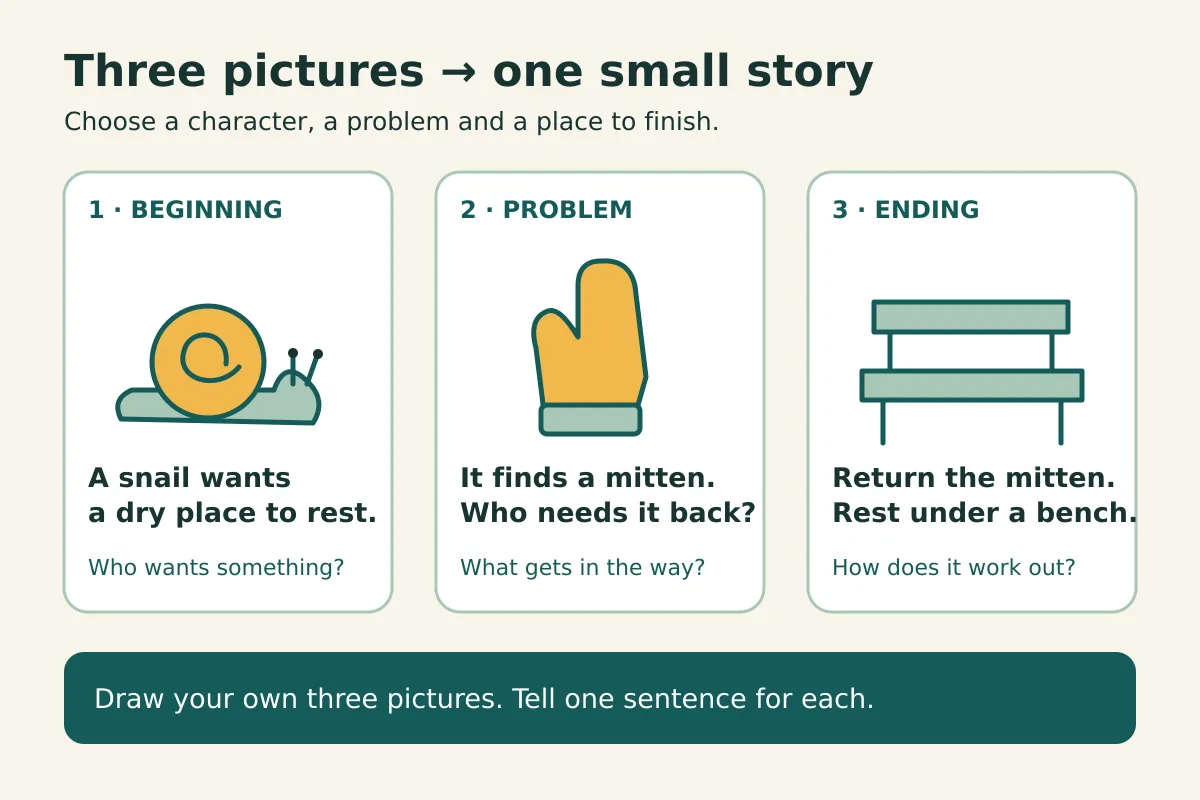
Draw three simple pictures and tell a story that uses all of them. The drawings can be rough: each only needs to remind you of a character, object or place.
- Let each player draw something, until you have three pictures.
- Pick a picture for the beginning. Ask, “Who wants something?”
- Use the second picture to introduce a problem: “What gets in the way?”
- Use the last picture to finish: “How does it work out?”
The cover shows a snail, a mitten and a bench. You could tell this story:
“A snail wanted a dry place to rest. It found a cosy mitten, but a child came looking for the lost mitten. The snail showed the child where it was, then rested under a bench.”
For a younger child, you can tell the sentences while they point to each picture. An older child might rearrange the pictures and tell a different story: perhaps the mitten is a puppet performing on the bench, and the snail is its audience.
If drawing feels like another task, write the three words instead and read them aloud. For a roll-and-tell variation, PBS KIDS has a printable story-cube activity that combines a character, setting and object; a grown-up should help with cutting.
3. Two-path storyteller: let a child choose what happens
One person narrates a scene and offers two possible actions. Another chooses an action, and the narrator invents what happens because of it. Swap roles whenever your child wants to try telling.
Start here:
“A squirrel has a parcel for a neighbour, but the address has washed away. Should the squirrel ask at the bakery or look for a name on the parcel?”
If your child picks the bakery, the baker might recognise the ribbon and point to a house. If they inspect the parcel, they might find a drawing of that house beneath the wrapping. Continue from the chosen discovery, then let the squirrel deliver the parcel.
Make both options usable. “Ask the baker or give up forever” steers the child instead of offering an interesting choice. Two places to look or two ways to help give the storyteller more to work with.
If your child suggests a third action, you can follow it. These are stories you’re making together; the two options are there to help someone get started.
What if a child goes quiet or everyone wants a turn?
- No idea comes: offer a concrete prompt. “Who might be in the bakery?” is easier to answer than “What happens next?” Let them pass if they prefer.
- One player takes over: keep each turn to one sentence or one choice, and return to the agreed order.
- The story becomes too frightening: move to a helpful discovery: “The shadow was a coat hanging on the gate.” Ask what kind of adventure everyone wants before starting again.
- Nobody knows how to end: return to the opening wish. Did the cake reach the party, the snail find shelter or the parcel reach its neighbour? Once that happens, you can stop.
When you’d rather read than invent
Forever Soya makes illustrated choose-your-path adventures that families can read together; The Cloud Picnic for ages 4–6 lets your child choose where Nori explores and which cloud inspires the picnic story. The complete adventure is free to read and replay without signup or payment. For more ways to share a ready-written adventure, see how to read interactive stories together.